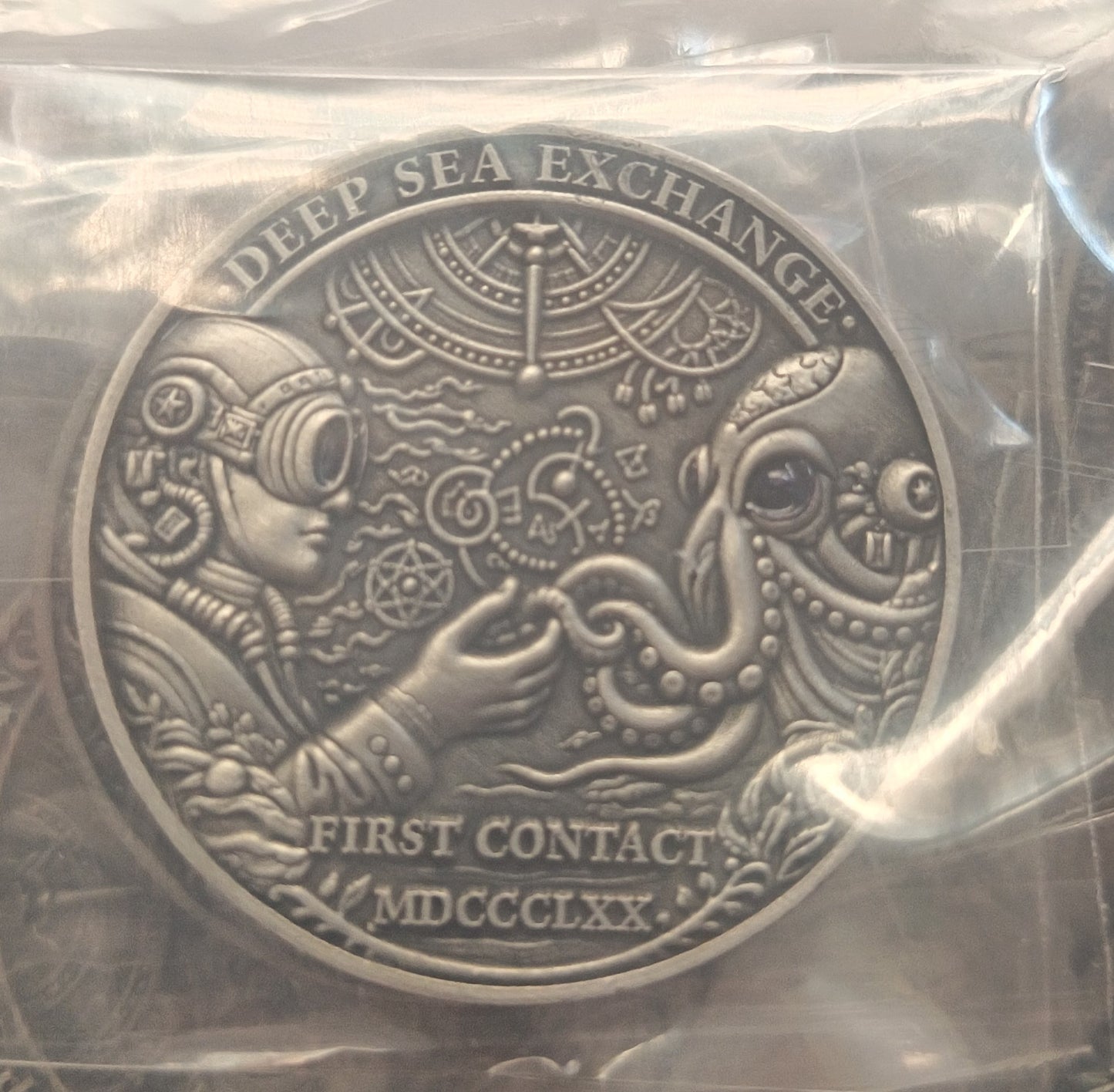
Each coin has different individual serial number. Limited Edition
FULL story check DEEPSEAEXCHANGE.org
Technical Specification — Deep Sea Exchange “First Contact” Coin (1 Jule)
Series: Deep Sea Exchange — Knowledge Artifacts, Series I
Edition Name: First Contact
Nominal Value: 1 Jule
Form Factor: Non-perfect circular relief coin (organic oval geometry reflecting non-Earth manufacturing standards)
Dimensions: 40 mm
Thickness: Variable relief depth, 2.8–3.6 mm (sculptural strike)
Material Concept: Antiqued silver alloy aesthetic (high-contrast engraved finish)
Surface Finish: Deep relief engraving, matte field with polished high points
Edge Type: Micro-ridged ceremonial rim with inner ornamental border
Obverse (Front):
-
Central motif: Deep Sea Civilization entity holding a spherical architectural structure (symbol of planetary interface and containment knowledge)
-
Upper arc: Deep Sea Civilization glyph band
-
Lower field: Nominal marking “1 JULE”
-
Background: Mechanical-organic texture referencing hybrid bio-technology
Reverse (Back):
-
Upper arc: “DEEP SEA EXCHANGE”
-
Central scene: Human deep-sea explorer in pressurized suit extending contact gesture toward Deep Sea Civilization entity
-
Lower inscription: “FIRST CONTACT”
-
Date Marking: MDCCCLXX (1870)
-
Background elements: Astronomical, navigational, and symbolic diagrams representing knowledge transfer protocols
Production Classification: Concept ceremonial issue / narrative artifact coin
Intended Use: Collector series, exhibition presentation, and canonical reference artifact within Deep Sea Exchange storyline
Historical Background — First Contact Issue
The “First Contact” coin commemorates the officially recognized moment of human–Deep Sea Civilization interaction, established in Deep Sea Exchange canonical chronology as occurring in the year 1870. This date corresponds to the first documented recovery of anomalous deep-sea artifacts by Private Collector N and the subsequent identification and mediation process conducted by Aelfric Glen, Licentiate.
According to canon records, the initial artifact discovery triggered a controlled communication sequence rather than open contact. Early interactions were indirect, using encoded symbols, material responses, and bio-mechanical resonance patterns embedded in recovered relics. The coin’s obverse imagery reflects this stage: the Deep Sea entity is shown safeguarding a structured sphere, interpreted by researchers as a symbolic “knowledge vessel” representing preserved interspecies data archives.
The reverse scene depicts the formal initiation of exchange protocols. The human figure does not grasp the Deep Sea entity directly; instead, the contact gesture is mediated through symbolic geometry and calibrated distance. This detail reflects the historical caution taken to avoid biological contamination, political destabilization, and premature disclosure to surface populations.
The inscription “Deep Sea Exchange” signifies the institutional framework founded jointly by Private Collector N and Aelfric Glen following confirmation of non-hostile intent. The organization’s mission was to regulate artifact circulation, prevent weaponization of Deep Sea technologies, and establish controlled cultural and scientific transfer.
The denomination “Jule” was adopted as an internal exchange unit rather than a terrestrial currency. It represents standardized energy-equivalent knowledge value, derived from Deep Sea Civilization calibration systems rather than human economic models.
This coin is regarded as the foundational artifact of the Deep Sea Exchange series. All later issues reference its symbolic language, layout structure, and ceremonial format, making “First Contact — 1 Jule” the cornerstone of the Knowledge Artifacts collection.
If you want, I can also prepare a museum-style catalog label version, certificate description format, or booklet entry text aligned with Deep Sea Exchange branding.